
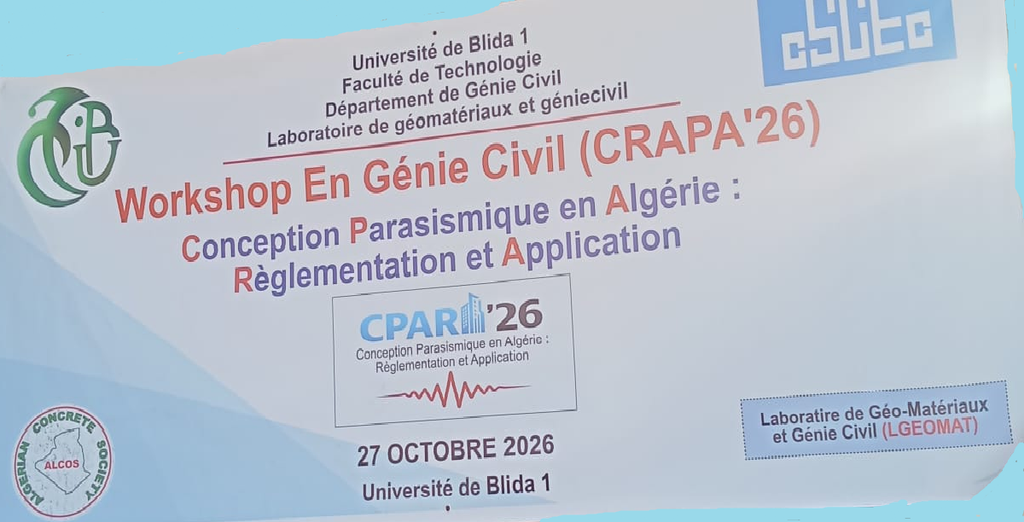
University of Blida 1 hosts a scientific workshop on the latest developments in earthquake-resistant design in Algeria
In keeping with scientific and technological developments in the field of civil engineering, the University of Blida 1 hosted, on Tuesday, October 27, 2026, the activities of the scientific workshop entitled “Earthquake-Resistant Design in Algeria: Organization and Application” (CPARA’26), which was organized by the Department of Civil Engineering at the Faculty of Technology, in cooperation with the Laboratory of Geological Materials and Civil Engineering (LGEOMAT), in the main lecture hall of the university sports complex.
The opening ceremony of this scientific event was held under the supervision of the University Director, Professor Bezina Mohamed, in the presence of the Director of the National Higher School of Irrigation, along with the Vice-Rector of the University in charge of External Relations, the staff of the Faculty of Technology, headed by the Dean, and a group of research professors, experts and representatives of specialized professional bodies and institutions.
In his opening remarks, the university director stressed the importance of organizing such specialized scientific meetings to keep pace with regulatory and technical developments, and to enhance interaction between academic research and professional practice, in order to support the development of engineering solutions and establish more effective approaches in designing facilities and ensuring their safety in the face of seismic risks.
For their part, the organizers of the workshop confirmed that this initiative aims to provide a scientific space for exchanging ideas and experiences on earthquake-resistant design in Algeria, and to discuss updates to the RPA 2024 system and its practical applications, in order to contribute to the development of engineering practices and enhance the safety of facilities.
RPA 2024 updates are at the heart of the scientific debate.
The workshop provided a scientific space to discuss the updates brought about by the Algerian Anti-Earthquake System RPA 2024, through a rich program that addressed the assessment of seismic risk and the updating of seismic classification maps, geotechnical studies, the calculation of reinforced concrete structures, as well as the transition from traditional design to performance-based design.
The program included a series of scientific presentations by researchers and experts who addressed the theoretical and practical aspects of the new organization, along with practical case studies that highlighted how its requirements could be used in the design of facilities, in addition to opening the floor for discussion and exchange of views on the technical challenges associated with its application.
The importance of geotechnical studies in assessing the seismic response of structures was also highlighted, along with introducing modern approaches to earthquake-resistant design and promoting communication between the university and consulting firms and professional institutions active in the construction and public works sector.